

In Steve (2025), directed by Tim Mielants, Jay Lycurgo plays Shy and Cillian Murphy stars as Steven. In one of the film’s defining stills, the two stand in a grassy field dotted with dandelions. Shy smiles brightly, wearing a green hoodie, a backpack, and a Walkman whose headphones rest around his neck. Steven, seen from the side in a blue blazer, holds an object in his hands—something the two men study intently. A parked car stands in the distance near the tree line.
Director: Tim Mielants | 93 minutes | Comedy, Drama
Cast: Cillian Murphy, Tracey Ullman, Jay Lycurgo, Roger Allam, Luke Ayres, Joshua Barry, Charles Beaven, Leanne Everitt, Archie Fisher, Marcus Garvey, Lois Haidar, Ahmed Ismail, Youssef Kerkour, Shelley Longworth, Douggie McMeekin, Tom Moya, Joshua J Parker, Little Simz
Steve is pushed to his limits. Played with remarkable restraint by Cillian Murphy, he attempts—almost desperately—to guide troubled teens who have been abandoned by the system. In an environment where “whatever” seems to be the universal response, Steve battles impulsivity, aggression, and indifference on a daily basis. He is a headteacher at a reform school for youths society has long written off. Together with colleagues Amanda (Tracey Ullman), Shola (Little Simz), and Andy (Douggie McMeekin), he wages a daily war: teaching, caring, stabilizing, feeding. Even the smallest spark can collapse the fragile balance. Over the course of one extraordinarily chaotic day, a documentary crew arrives, the school receives news of its funding being cut, and the property is set to be sold. Despite his dedication, Steve is clearly drowning too.
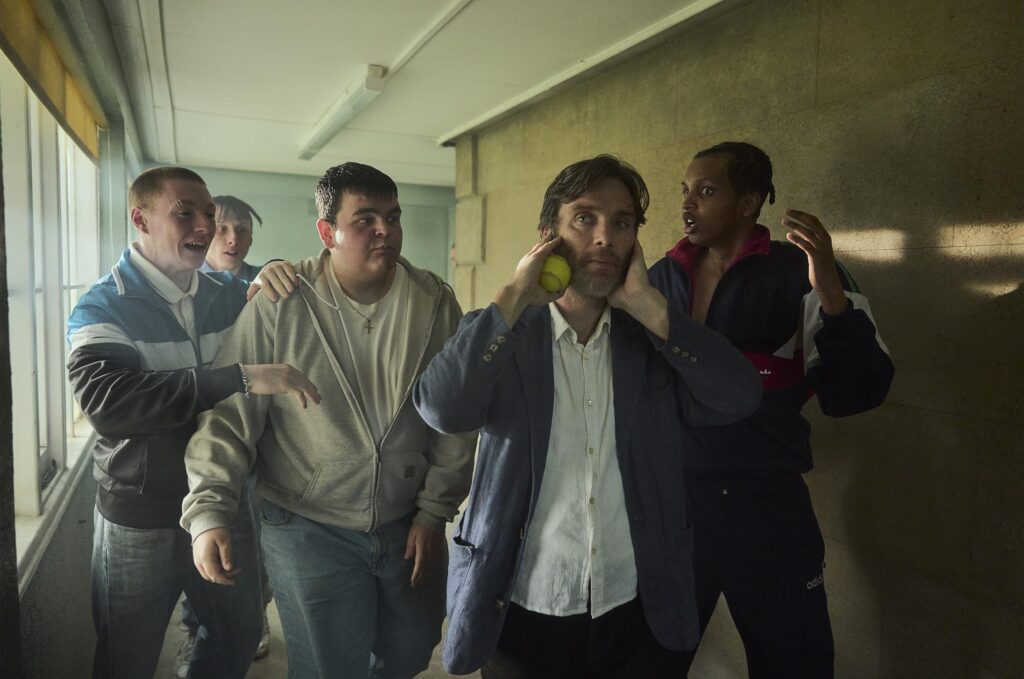
Mielants’ decision to compress the story into a single day heightens the urgency. Each escalating crisis intensifies the pressure—on Steve, the students, and the viewer. The director blends documentary-style realism with dramatic tension to create breathing space, especially in the interview moments that provide nuance and insight. The handheld camera work and intimate close-ups deliver raw authenticity, making us feel physically present in the corridors of the school. Not every stylistic choice lands equally well: a sleek drone montage near the end breaks the intimacy, impressive but tonally jarring. More successful is the recurring motif of stones—a subtle symbol that evolves from humorous to deeply emotional, representing anger, loss, and eventual release. Mielants and Murphy prove once again to be a formidable pairing; Murphy’s layered performance anchors the film while Mielants asks bold questions about responsibility, guilt, and the thin boundary between care and collapse. Steve is not an easy film—but it is one that lingers.